Report
Adoption is nearly universal. Real value is rare. The reason is the method built around the tool, not the tool itself.
Nearly seven in ten legal professionals now use generative AI in their daily work. Yet across most law firms, that widespread adoption has yielded almost no measurable return. Partners and associates open tools in browser tabs to draft quick emails or summarize text, but the underlying business remains unchanged. Financial margins, work product, and client service look identical to how they did three years ago.
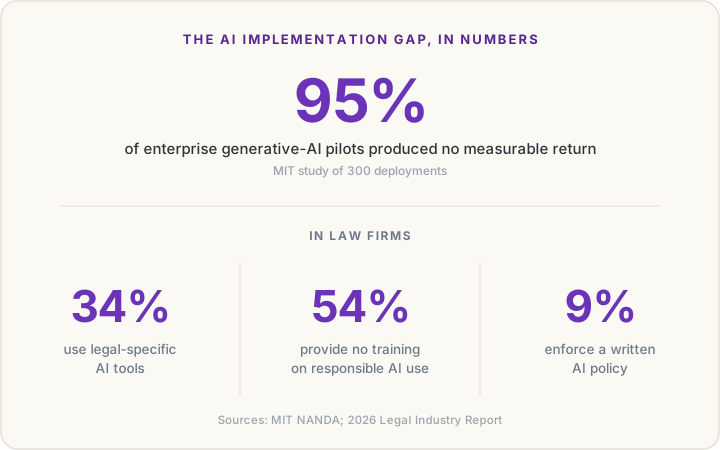
This gap between individual usage and enterprise value is not unique to the legal industry. Researchers at MIT studied 300 enterprise AI deployments and found that a staggering 95 percent of generative AI pilots failed to produce a measurable return on investment. Companies of all kinds have announced major AI initiatives, only to see nothing arrive at the bottom line.
The problem is rarely the underlying software. Flexible, general-purpose tools perform well for individual tasks straight out of the box because they are fast, adaptable, and easy to use. But because generic tools are completely unopinionated, serving out of the box as 'blank slates', they stall at an organizational level.
In practice, the operational reality inside most firms remains fragmented. Lawyers utilize different tools on their own, using subjective prompts, without a unified method, firm-specific context, or formal oversight. Standard software does not know how a specific firm evaluates risk, negotiates contracts, or trains junior associates.
In law firms, this integration gap creates immediate operational and governance risks. Data from the 2026 Legal Industry Report shows that only 34 percent of firms use legal-specific AI software, while the rest rely on generic consumer or enterprise applications.
Relying on generic applications is not inherently a mistake. In fact, general-purpose models often offer greater long-term flexibility and power than specialized vendor tools. However, generic software requires deliberate, firm-level work to build out prompt standards, data security guardrails, and practice-specific workflows. Without that internal architecture, generic tools remain uncalibrated, risky, and will not provide the measurable value that a firm is looking for.
Today, more than half of firms provide zero training on responsible AI usage, and fewer than ten percent actively enforce a written AI policy. Beyond confidentiality risks, relying on default models (whether legal-specific or not) quietly dilutes a firm's competitive edge. Uncalibrated prompts generate generic templates, stripping away the distinct style, nuance, and strategic judgment clients pay for.
Worse, misapplying AI to complex legal analysis can actively degrade work quality. A Harvard Business School study conducted with Boston Consulting Group found that while generic AI improved performance on broad brainstorming tasks by 40 percent, it reduced accuracy on deep analytical tasks by 19 percent. Confident, polished prose easily hides thin reasoning and missed issues. These are the exact vulnerabilities lawyers are paid to catch, and if left unnoticed, opposing counsel will easily exploit them.
The ultimate difference between wasted AI and high-value AI is never the underlying model; it is the organizational method built around it.
The law firms successfully extracting value from AI are not necessarily the ones buying expensive, niche legal software. More often, they are the ones approaching AI intentionally - leveraging powerful, adaptable general models paired with their own internal practice methodology. Real quality and economic returns come from aligning software with specific firm standards.
Thomson Reuters data shows that firms with an articulated AI strategy are nearly four times more likely to see tangible organizational benefits than those operating without one. Targeted integration can save an estimated 190 hours per lawyer each year, freeing up time for higher-value client work and strategic growth. But those gains belong exclusively to firms that establish clear structure first, defining where software helps, where human judgment is non-negotiable, and how work product is validated.
Buying software licenses does not change how a law firm operates. The gap between individual adoption and firm-level value only closes when an organization codifies its own practice methodology and enforces its AI processes around those standards. Generic software vendors offer raw capability, but turning that capability into an institutional asset requires an institutional framework. That is the work Codified Counsel was built to deliver.
← Back to insights See how we close the gap →The value is real, but it goes to firms that build the method first. That's the work we do: codify how your firm practices, then fit and govern the tool to it.
Schedule a discovery call → Codified Counsel